
Will and orbits
"A king is one who knows his own will": sovereignty over oneself
The saying on inner kingship: for Maestro Cornelio the true king does not rule over others, but knows his own Will and fulfils it, day after day.
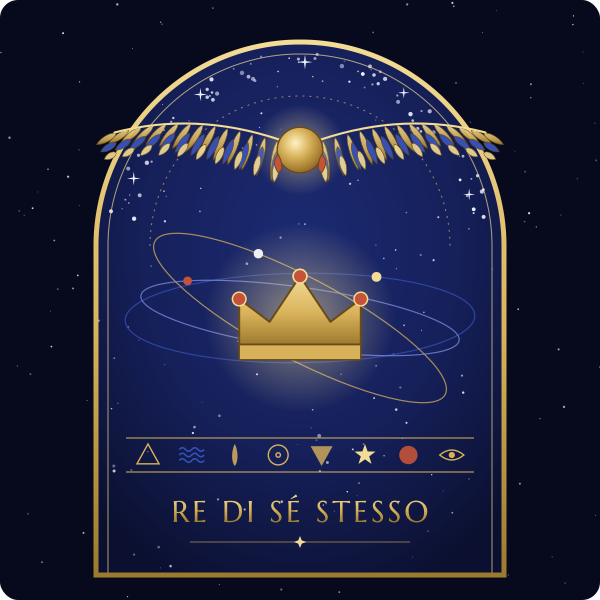
Among the sayings the Studio reads and comments on, there is one that surprises those who meet it for the first time: "A king is one who knows his own will and fulfils it." Maestro Cornelio considers it one of the keys of the teaching, because it overturns the common idea of power. The king the Law speaks of sits on no throne and has no subjects. His crown is invisible, and his kingdom is a single one: himself.
A different kingship
In history, kingship has almost always meant power over others: commanding, owning, deciding the lives of others. The Master observes that this kingship is fragile, because it depends on what one cannot control: the loyalty of subjects, the fortune of arms, the favour of the times. And often those who govern many do not govern themselves: they are slaves to the fear of losing power, to ambition, to flattery.
The kingship of the Law is the opposite. It needs no one beneath it. It is the condition of someone who does not let themselves be governed by their impulses, nor by other people's opinions, but acts from their own centre. This is why the Law can say that every star is sovereign: not because it dominates the others, but because none of them needs to be dominated.
Knowing and fulfilling
The saying has two verbs, and the Master asks us not to separate them. Knowing one's will is the work of listening: telling true Will apart from desires, recognising one's orbit. But whoever knows and does not act, the Master warns, is a king in exile: he knows who he is and does not dare to be it. Fulfilling is the work of courage: turning knowledge into action, in the present, in the concrete choices of every day.
This is where the third of the Three Voices of the Law comes in, the voice of Force, linked to the Name of Ra-Hoor-Khuit: the power that realises Will in the world. A king who knows without acting is only a dreamer; one who acts without knowing is a tyrant over himself. True kingship unites the two.
A king is one who knows his own will and fulfils it.
Governing oneself
What does governing oneself mean, concretely? The Master points to three domains. The first is attention: deciding where to place it, instead of letting every stimulus carry it off. The second is speech: saying what one wants to say, in the right way and at the right time, instead of reacting. The third is the deed: doing what one has decided to do, even when no one is watching and even when it costs effort. Each of these is a province of the inner kingdom, and each must be won with patience.
No one beneath us
There is a risk, and the Master names it clearly. Whoever discovers they are sovereign over themselves may be tempted to feel superior to others. But the Law closes this door: if every man and every woman is a star, every star is sovereign. The king of the Law recognises in every person another king, with their own kingdom and crown. This is why inner kingship produces not arrogance but a deep courtesy: the courtesy shown between equals.
Day after day
Kingship, the Master concludes, is not won once and for all. It is exercised every day, in small things more than in great ones. Every time we choose according to our orbit rather than our fear, the crown grows stronger; every time we betray ourselves, it cracks. There is no reason to despair over falls: the kings of history lost battles too. What matters is returning to the centre and beginning to govern again.
The image accompanying this entry is a golden crown beneath the winged disk: the symbol of a sovereignty that weighs on no one's head, because it is made of light.
Watch the video
Read next
True Will: listening before acting
How does one recognise one's orbit? Maestro Cornelio teaches that Will is not invented but discovered, and that listening comes before action.
Respect for orbits: I am a star, you are a star
"I am a star, you are a star, each travels its own eternal orbit": the ethics of mutual freedom in Maestro Cornelio's teaching.
"Do what you will shall be the whole of the Law": the hinge of the teaching
The shortest and most misunderstood formula of the Law, explained by Maestro Cornelio: not an invitation to whim, but the task of discovering and fulfilling one's true Will.
