
The Law
"Do what you will shall be the whole of the Law": the hinge of the teaching
The shortest and most misunderstood formula of the Law, explained by Maestro Cornelio: not an invitation to whim, but the task of discovering and fulfilling one's true Will.
The whole of the Law, Maestro Cornelio teaches, lies in a handful of words: "Do what you will shall be the whole of the Law." It is the phrase that opens every greeting among those who follow it, and it is also the one most exposed to misunderstanding. People who hear it for the first time often hear a permission: do as you please. The Master answers that the opposite is true. It is not a permission but a task, perhaps the hardest one that can be entrusted to a human being.
To will is not to desire
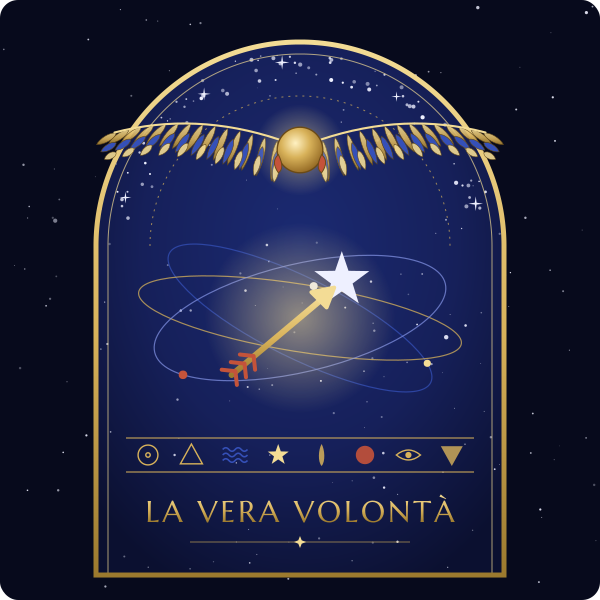
The key lies in the verb. In the Law, "to will" does not mean indulging the desire of the moment. Desires come and go, contradict one another, and are often not even ours: we receive them from habit, from fear, from the gaze of others. Will, with a capital W, is something else: it is the deep direction of a being, the trajectory that makes it what it is. The Master compares it to the orbit of a star. A star does not choose its orbit every morning: it travels it, and in travelling it is itself.
This is why the formula does not say "do what you desire" but "do what you will". Before doing, one must know what one truly wills. And to know it, one must listen: this is the teaching of true Will, which comes before every action.
The whole of the Law
The second half of the sentence is just as radical: this shall be the whole of the Law. Not one rule among others, but the only one. The Master explains that other rules, when they are right, descend from this one; when they do not, they are cages. The Law gives this cage a precise name: restriction. "The word of sin is restriction": to prevent oneself from following one's orbit, or to prevent others from following theirs, is the only true fault.
From this follows a demanding ethic. If every being has a right to its own orbit, no one has the right to invade another's. "You have no right but to do your will," says the Law. There is only one right, and precisely for this reason it grants nothing against others: whoever truly follows their own star has no need to take light away from anyone. It is the foundation of respect for orbits.
Free from the lust of result
There is one last step, which the Master considers the subtlest. The Law says that pure will, "free from purpose, delivered from the craving for results", is perfect in every way. One does not fulfil one's Will in order to obtain something: one fulfils it because it is one's own. Whoever acts only with a reward in view, the Master observes, is still a slave of desire, even when pursuing noble things. Whoever acts according to their orbit is free even when they fail, because the worth of the deed does not depend on its outcome.
Do what you will shall be the whole of the Law. Love is the law, love under will.
The greeting and the answer
Among those who follow the Law, the formula is also a greeting, and the answer is the other great sentence: "Love is the law, love under will." The Master insists that the two sentences always be said together. The first, on its own, could turn into pride; the second, on its own, into sentimentality. Together they say that each person's freedom is fulfilled in union, and that true union is born only between free beings. This is the theme of love under will.
A daily practice
What does it mean, in practice, to live by this formula? The Master suggests a simple exercise. Before an important choice, stop and ask: do I will this, or do I desire it? Does it come from my centre, or from fear, from habit, from the need for approval? The answer does not always come at once. But the question, repeated every day, changes the way one looks at one's life. Little by little one learns to recognise one's orbit, and to travel it firmly and without haste.
"Do what you will" is therefore not the motto of someone who has no rules, but of someone who has found the most intimate rule of all: their own true nature. Everything else in the teaching, from the Sacred Names to the Master's lamp, is a commentary on these few words.
Watch the video
Read next
Love under will: uniting without imprisoning
"Love is the law, love under will": how Maestro Cornelio explains the second great formula of the Law, which completes the first rather than contradicting it.
Every man and every woman is a star
The principle that grounds the dignity of every being in the Law: each of us is a star, unique and sovereign, with a light and an orbit of our own. Maestro Cornelio's commentary.
True Will: listening before acting
How does one recognise one's orbit? Maestro Cornelio teaches that Will is not invented but discovered, and that listening comes before action.
