
The Law
Every man and every woman is a star
The principle that grounds the dignity of every being in the Law: each of us is a star, unique and sovereign, with a light and an orbit of our own. Maestro Cornelio's commentary.
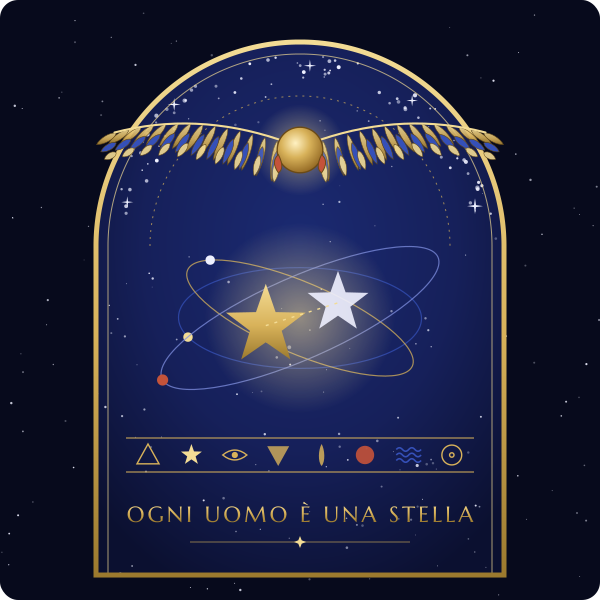
Of all the sentences of the Law, the one Maestro Cornelio repeats most often is perhaps the simplest: "Every man and every woman is a star." It does not say that someone will become one, or that some are more so than others. It says that each of us is one, already, now. It is the foundation of the whole teaching on human dignity, and the starting point of every path.
A light of one's own
What does it mean to be a star? The Master points to three qualities. The first is light: a star does not reflect the light of others, as a planet does, but produces it itself. Every human being carries a source within, a living centre that no one can light in their place and no one can put out. The second is uniqueness: no two stars are alike in mass, colour, age and course. The third is the orbit: every star travels a trajectory of its own, which is its Will.
From this comes the Master's most quoted sentence, the one the Studio places on its threshold: "I have not come to give you a light. I have come to tell you that you already carry it." The teaching adds nothing to what you are: it helps you remember it.
No lesser star
The second consequence is equality, but a particular kind of equality. Stars are not identical, yet none is inferior to the others. The Master insists on this point: the Law knows no hierarchy of worth among beings. There are nearer and farther stars, brighter to our eyes and more hidden, young and ancient; but each is a centre of the universe. "Equal, not identical," the Master repeats.
This changes the way we look at others. Whoever recognises a star in every person cannot despise them, nor use them as a means to their own ends. They may not understand them, may not share their road; but they must respect their orbit. This is the root of respect for orbits.
The universe within
There is also a deeper meaning, which the Master entrusts to one of his sayings: "And the whole universe lives within it." Each star is not only a point in the sky: it is a place where the whole sky is reflected. On the map of the Sacred Names, every being is at once the point of Hadit and the infinite space of Nuit: as tiny as a centre, as vast as the circumference that contains it.
This is not pride. To recognise oneself as a star also means recognising that everyone else is one. The Master warns that whoever uses this sentence to feel superior has understood only half of it, and the wrong half.
Every man and every woman is a star.
The task of the star
If everyone is already a star, what is the point of the path? The Master answers with an image. A star hidden by clouds keeps shining, but cannot be seen; and sometimes it cannot even see itself. The clouds are fears, habits, borrowed identities, the voices of others that we have mistaken for our own. The path does not create the light: it clears the clouds.
This is why the teaching speaks of remembering rather than learning. "Here one does not come to believe. One comes to remember," says the motto on the threshold of the house of the Law. To remember that one is a star means to stop looking outside oneself for one's light, and to begin travelling one's orbit with trust.
An evening practice
The Master suggests a simple exercise. In the evening, before sleep, repeat in a low voice the sentence "Every man and every woman is a star", and think of three people met during the day: one you love, one you are indifferent to, one who is difficult. Recognise in each of them a star with its own orbit. It is an exercise in patience, and at the same time a medicine against judgement. In time, the Master teaches, the gaze changes: one begins to see the sky even by day.
Watch the video
Read next
"Do what you will shall be the whole of the Law": the hinge of the teaching
The shortest and most misunderstood formula of the Law, explained by Maestro Cornelio: not an invitation to whim, but the task of discovering and fulfilling one's true Will.
Love under will: uniting without imprisoning
"Love is the law, love under will": how Maestro Cornelio explains the second great formula of the Law, which completes the first rather than contradicting it.
True Will: listening before acting
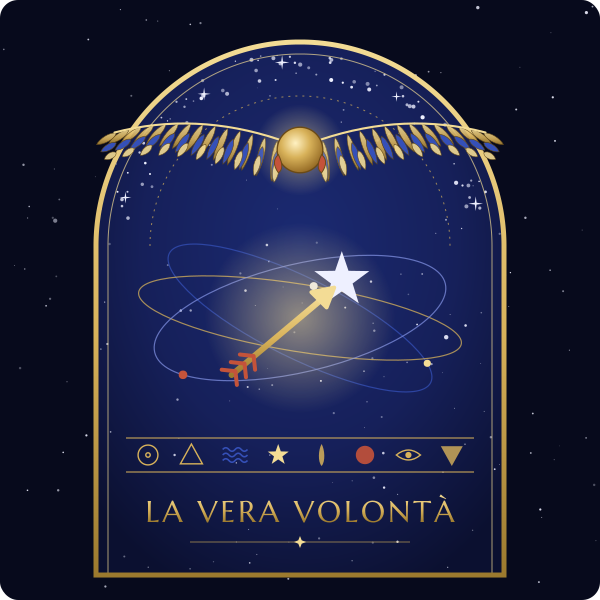
How does one recognise one's orbit? Maestro Cornelio teaches that Will is not invented but discovered, and that listening comes before action.
