
The Aeon and its symbols
"Existence is pure joy": a lamp in the night
"Remember that existence is pure joy; that all sorrows are but shadows": the saying Maestro Cornelio advises keeping close on difficult nights.
There is a saying of the Law that Maestro Cornelio calls "a lamp in the night". It is the one that says: "Remember, all of you, that existence is pure joy; that all sorrows are but shadows; they pass and are done; but there is that which remains." The Master recommends it to those going through a dark time, but also to those who are well and wish to understand where their joy comes from.
A sentence for the night
At first sight the sentence seems naïve, almost offensive to those who suffer. How can one say that existence is joy to someone who has lost a loved one, to someone who is ill, to someone who feels alone? The Master takes the objection seriously. The saying, he explains, does not deny pain: it names it. Indeed it says "all sorrows", without exception. But it points to their nature: they are shadows. And a shadow, however dark and real, exists only because there is a light.
Pain in its place
The heart of the teaching is a question of proportion. Pain, when it comes, tends to take up all the room: it seems that the whole world is made of that wound. The saying puts pain back in its place without denying it. It is a shadow passing over the background of something larger. The Master compares this background to the sky of Nuit: clouds can cover it for days, but the sky is never erased by the clouds.
Remember, all of you, that existence is pure joy; that all sorrows are but shadows; they pass and are done; but there is that which remains.
Shadows that pass
The second part of the sentence dwells on time: "they pass and are done". The Master observes that those who suffer often live in the illusion that pain is eternal. It is one of the cruellest features of suffering: it takes away the future. The saying gives it back. It does not promise that pain will vanish at once, nor that it will not return; it only reminds us that no shadow is permanent. In the longest nights, even this can be something to hold on to.
That which remains
And what remains? The saying does not say, and the Master considers this silence a kindness. What remains cannot be named from outside: each person discovers it within. For some it is the love they have received and given; for others the certainty of being a star, with an orbit that no loss can cancel; for others still the inner fire of Hadit, which burns even under the ash. The joy the Law speaks of is not the cheerfulness of the moment: it is the awareness of this permanence.
Joy as foundation
Here the Master touches one of the most original features of the Law. Many traditions have described existence as a vale of tears, a trial to be endured while waiting for something else. The Law describes it instead as joy. Not because it ignores evil, but because it places joy at the foundation and pain on the surface. It is, the Master teaches, one of the signs of the new age of consciousness: a way of being in the world that does not ask us to flee life, but to live it fully.
This joy is not a duty, nor a mask to wear. The Master warns against those who use it to deny their own wounds or other people's. The joy of the Law also welcomes tears: it is the calm ground over which tears flow.
A lamp in the night
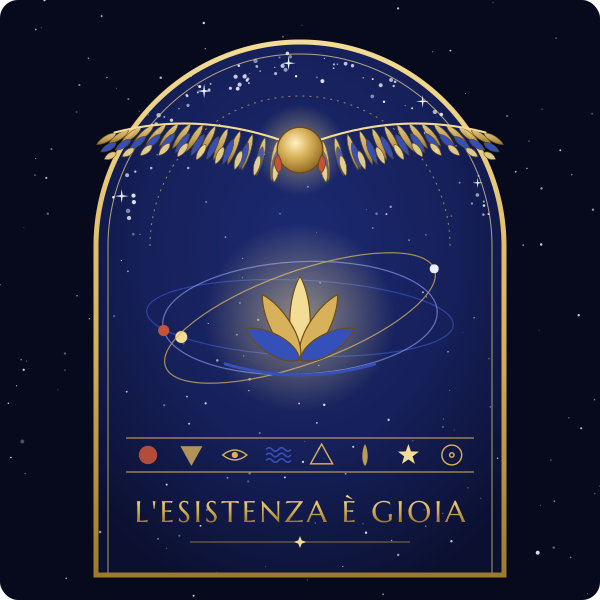
The Master advises using this saying as one uses a lamp: lighting it when it grows dark. On difficult evenings, read it in a low voice, slowly, just once. Do not try to convince yourself, nor to feel better at once. Let the words do their work, like a small flame in a large room. And then remain in silence, listening to what remains. The lotus that accompanies this entry recalls the same teaching: the purest flower is born from the mud, and opens to the light without denying its roots.
Watch the video
Read next
Abrahadabra, the end of words: the seal of the Law
"The end of words is the Word Abrahadabra": Maestro Cornelio explains the Word that seals the Law, a symbol of the union of opposites and of the silence that follows.
"Do what you will shall be the whole of the Law": the hinge of the teaching
The shortest and most misunderstood formula of the Law, explained by Maestro Cornelio: not an invitation to whim, but the task of discovering and fulfilling one's true Will.
Love under will: uniting without imprisoning
"Love is the law, love under will": how Maestro Cornelio explains the second great formula of the Law, which completes the first rather than contradicting it.
