
The Aeon and its symbols
Abrahadabra, the end of words: the seal of the Law
"The end of words is the Word Abrahadabra": Maestro Cornelio explains the Word that seals the Law, a symbol of the union of opposites and of the silence that follows.
The Law closes with a mysterious sentence: "The end of words is the Word Abrahadabra." Maestro Cornelio considers it the seal of the whole teaching: after everything that could be said has been said, a single Word remains, and after it, silence.
After all the words
Why does the Law end with a word that seems to mean nothing? The Master answers that this is precisely the point. Words serve to distinguish, to explain, to point; but what the Law points to in the end cannot be explained. It is an experience of union, and union cannot be said: it can only be lived. Abrahadabra is the word that marks this boundary. It is the last word before silence, and at the same time the word that contains all the others.
The voice of Force
In the Three Voices of the Law, the saying about Abrahadabra belongs to the third voice, the voice of Force, linked to Ra-Hoor-Khuit. This is no accident, the Master explains. Force is fulfilment: the moment when the meeting between the space of Nuit and the point of Hadit becomes reality. Abrahadabra is the name of this fulfilment, the formula of a work finally accomplished.
The end of words is the Word Abrahadabra.
Only one remains
The Master invites us to look at the word itself. Whoever pronounces it slowly hears a regular structure, almost a dance of syllables that turns back on itself. In the esoteric tradition, words of this kind have been read as formulas: not sentences that describe the world, but sounds that sum up its order. Abrahadabra recalls by resemblance the ancient formula "abracadabra", used for centuries as an amulet; but the Law transforms it, changes one letter and charges it with a new meaning.
The Master does not dwell on the calculations and correspondences that students of numbers have built around this word. He prefers to point to its simplest meaning: the union of opposites.
The union of opposites
In Abrahadabra, the Master explains, what rises and what descends meet, the circle and the cross, five and six: the human microcosm and the macrocosm of the universe. It is the same union the Law calls love, the union that draws the point towards space and space towards the point. Every true work, from the making of a work of art to the transformation of oneself, is a small Abrahadabra: two different realities uniting and giving life to a third.
This is why the Word is also called the word of the Great Work: the name of the inner labour by which a human being unites their own polarities within and becomes whole.
The word and the veil
There is also a teaching about language. The Master observes that words are veils: they show and hide at the same time. The more one tries to explain the experience of union, the further one pushes it away. Abrahadabra is a very thin veil, almost transparent: a word that does not claim to explain, only to point. Behind it there is no secret to uncover, but a silence to inhabit. It is the same lesson as another saying, the shortest of all: "There is nothing else."
Syllable by syllable
The Studio suggests using the Word as a meditation. Pronounce it slowly, syllable by syllable, in a low voice; then repeat it only in thought; then let it go and remain in the silence that follows. The Master warns against treating it as a magic formula that produces effects, but rather as a door. Whoever passes through it finds no hidden treasure: they find the stillness in which all words come to rest.
Then silence
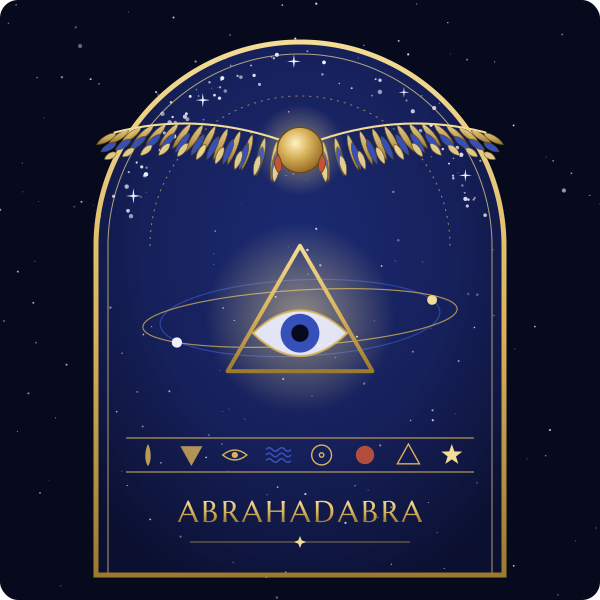
The open eye in the triangle that accompanies this entry recalls that the silence after the Word is not sleep but wakefulness. It is the clear gaze of someone who has stopped speaking in order to see. So the Law closes, and so the Master closes every teaching: with a word, and then silence. The rest, as he likes to repeat, will reveal itself.
Watch the video
Read next
"Existence is pure joy": a lamp in the night
"Remember that existence is pure joy; that all sorrows are but shadows": the saying Maestro Cornelio advises keeping close on difficult nights.
"Do what you will shall be the whole of the Law": the hinge of the teaching
The shortest and most misunderstood formula of the Law, explained by Maestro Cornelio: not an invitation to whim, but the task of discovering and fulfilling one's true Will.
Love under will: uniting without imprisoning
"Love is the law, love under will": how Maestro Cornelio explains the second great formula of the Law, which completes the first rather than contradicting it.
